Refrigerator motor noise is usually normal when it is a steady, low hum from the compressor or a soft rush of air from a fan. It usually means a fault when it grinds, squeals, rattles or clicks again and again without the hum settling in. A built-in has at least three motors: the compressor, the condenser fan beside it and the evaporator fan inside the freezer, plus an ice maker and water valve. Start with location. Listen at the grille, then open the freezer door and listen again. On many models the freezer fan pauses when that door opens, so a sound that stops right then is almost always the fan.
Sounds a healthy unit makes
Plenty of what owners call motor noise is a refrigerator doing its job:
- A low hum from the machine compartment that drifts up and down in pitch as a variable-speed compressor matches the load.
- A gentle whoosh at the grille from the condenser fan.
- Gurgling right after the compressor stops, as refrigerant settles.
- Ticks and pops while the liner warms and cools around a defrost.
- A short buzz, then a thud: the water valve filling the ice tray, then cubes dropping.
Some settings raise the volume on purpose. On a 5 Series built-in, FAST COOL runs the compressor at high speed for 2 hours, and MAX REF and MAX FRZ hold the coldest settings for four and 6 hours. Viking also allows 24 hours after plug-in for the cabinets to reach the setting, so a hard-working hum on day one of a new install is expected.
Noises that point to a failing part
| Sound | Likely source | Owner check | Call when |
|---|---|---|---|
| Ticking that stops when the freezer opens | Fan blade hitting frost | Frost on the freezer back wall | Frost returns |
| Whine or squeal inside the freezer | Worn evaporator fan motor | Does it fade as it warms? | It gets louder |
| Rattle at the grille | Condenser fan or loose cover | Clear lint from the grille | Fan stalls or wobbles |
| Click, silence, click | Compressor not starting | Outlet power, no extension cord | Right away |
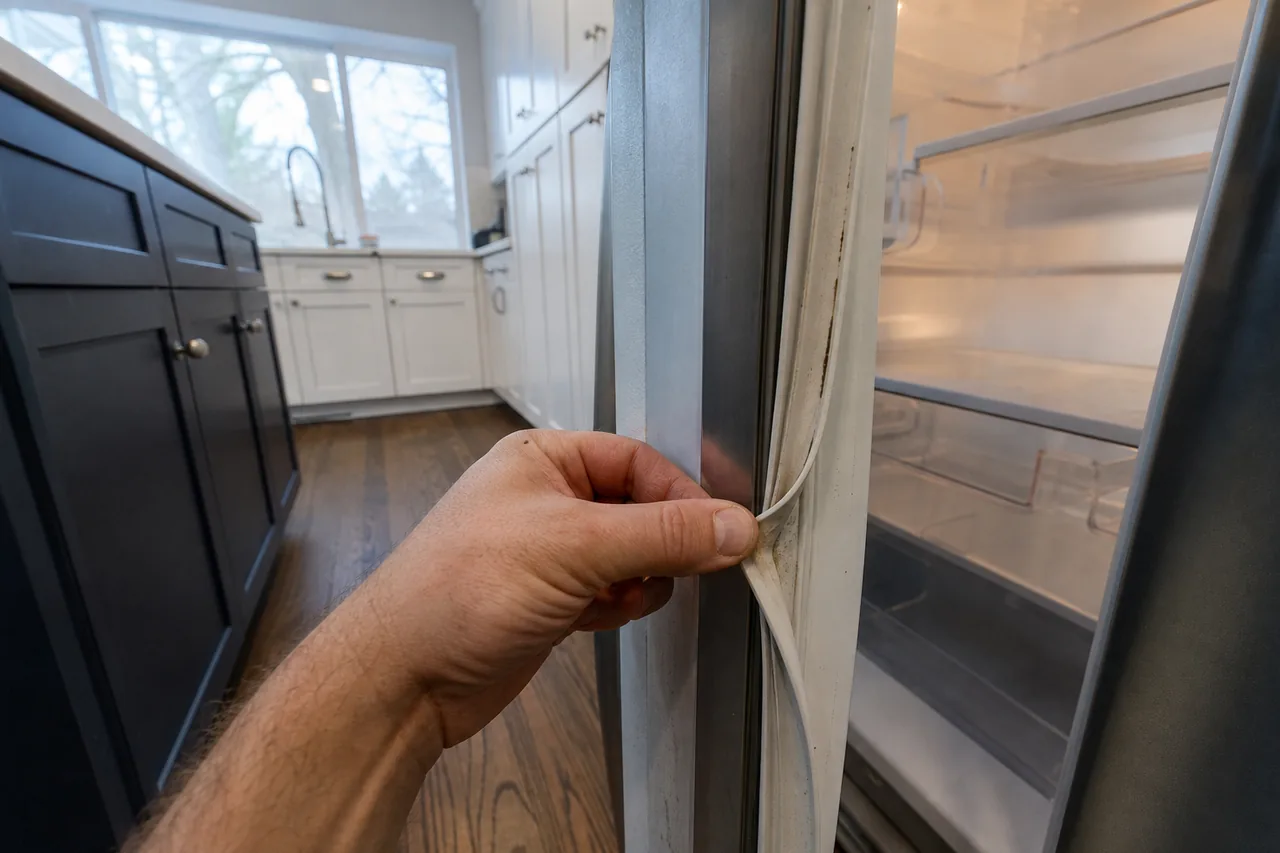
| Endless hum, warm cabinets | Dirty coil, leaky gasket or sealed system | Clean coil, test seal | Still warm after cleaning |
A compressor that never rests
A hum that never pauses is rarely a broken motor on its own. Usually the system cannot get rid of heat quickly enough, because the condenser is dusty or a door is leaking air.
Viking builds coil reminders into several models. On integrated VRI and VFI columns, a blinking CL in the temperature display asks for a condenser cleaning, which Viking schedules every 6 months; pressing the up and down arrows together for 3 seconds clears it. FDREIC and FDBMIC7360 units show CHECK COND. on that same 6-month cycle: turn the unit off, wait about 30 minutes, remove the grille under the door, brush and vacuum the coil, then restart and reset the reminder. The 5 Series has a Super Clog-Resistant pin-and-tube condenser that normally needs nothing, though a narrow vacuum nozzle clears any dust that gathers.
Next, the door seals. A stiff or grimy gasket admits warm, damp air, and in a humid Northeast Florida summer that keeps the compressor chasing moisture along with heat. Viking wants gaskets washed every three months with mild detergent or 4 tablespoons of baking soda per quart of warm water, then wiped with a light film of petroleum jelly so the rubber stays soft. To find a gap, shut a sheet of paper in the door at the top, side and bottom and tug it; a spot where it pulls free with no resistance is leaking.
Ice maker and water valve sounds
The ice maker’s small motor turns the ejector, and the valve at the back buzzes while water flows. Both should be brief. A long buzz with no water reaching the tray points to a closed supply, a pinched line or a tired valve. For a 5 Series ice maker that has stopped, Viking lists four checks: the signal arm down in the on position, a freezer cold enough (overnight, sometimes), the water valve open and no leak in the line.
When the noise needs a technician
Book service when the compressor clicks without starting, when a new sound comes with rising temperatures, or when a fan squeal worsens week by week. Unplug the unit if anything smells hot. To confirm cooling is slipping, follow the USDA method: a thermometer standing in water mid-cabinet, checked after 5 to 8 hours, should read 38 to 40 °F.
A visit begins with the $80 diagnostic, which identifies the motor at fault. As a typical range, a refrigeration fan or defrost repair is $250–$640 and compressor or sealed-system work is $950–$2,560, with the firm figure after diagnosis. The Viking refrigeration repair page describes the service and the pricing page explains what is covered. Ironwood handles Viking refrigeration in Mandarin, Beauclerc, Loretto and the neighborhoods around them, using genuine OEM parts.