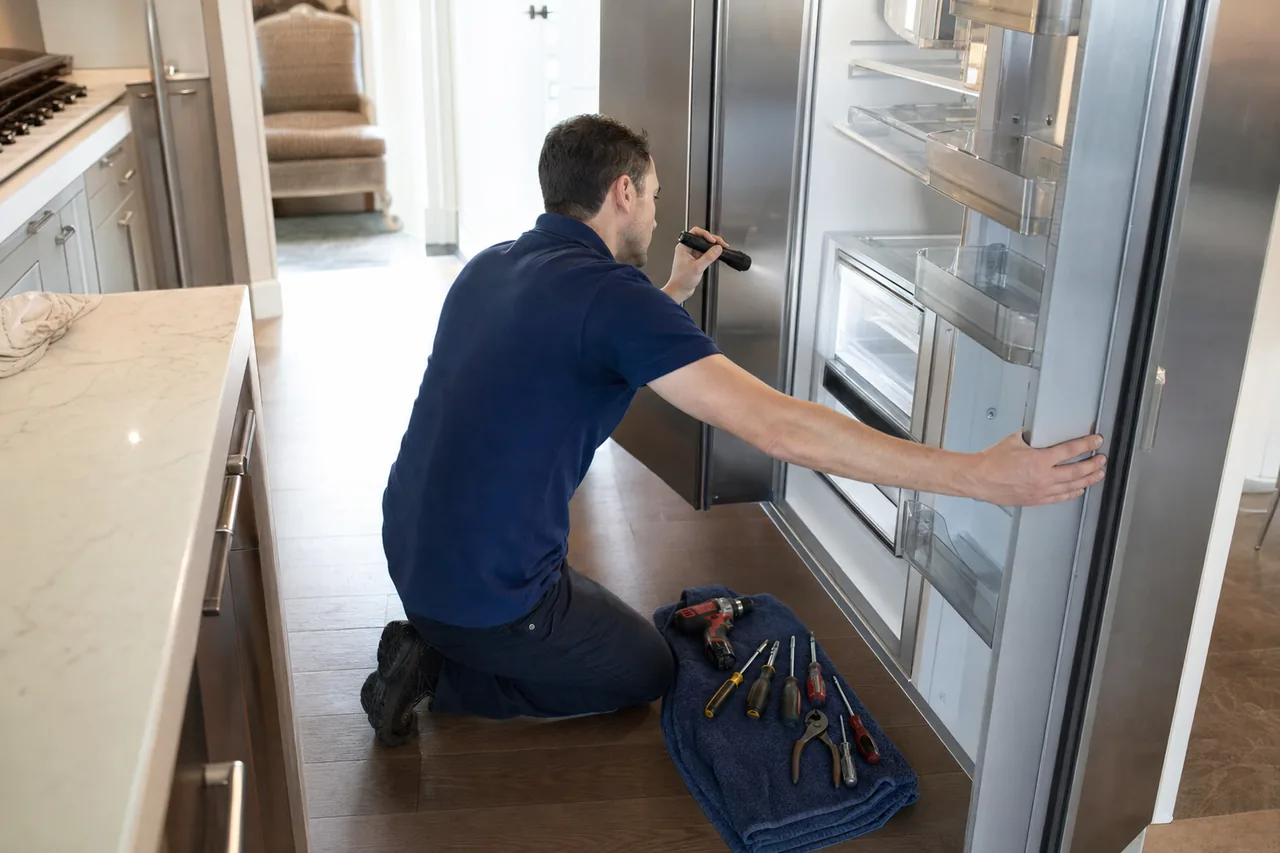
Every appliance in a professional kitchen is a box that has to hold something in: heat, cold, or water under pressure. The part doing that job is a strip of rubber or silicone and a door that is hung squarely enough to press it. When the seal is marginal, the appliance behind it works harder to reach the same result, and the symptom that reaches us is almost never described as a door problem.
That is why a seal is on our list before a component is.
What a failing seal looks like from the front
An oven that reads low, or takes forever to preheat. Heat leaking at the top corners of a door is invisible and constant. The element runs longer, the thermostat cycles more often, and a thermometer on the centre rack settles ten or fifteen degrees under the set point and stays there. Fitting a new sensor to that gets you a new sensor and the same reading.
A refrigerator that runs almost continuously. A marginal gasket lets humid air into a cold cabinet all day. The compartment mostly holds temperature, so nobody suspects the door, but the compressor runs longer, frost builds on the evaporator faster, and the defrost cycle runs more often than it was designed to. On a humid afternoon here that is a meaningful load.
A dishwasher that leaves the floor damp. Not a puddle — a damp line along the bottom of the door, or a warped spot on a cabinet side. That is usually the lower corners of the door seal, or a latch that is pulling the door tight in the middle and not at the edges.
How we test one
Springback. Press the gasket with a thumb and let go. A sound gasket returns to shape immediately. One that has gone hard stays compressed, or returns slowly, and it will look perfectly clean while doing it. Age and heat do this, not dirt.
The paper test, all the way round. Close the door on a strip of paper and pull. It should drag with consistent resistance at every point — both sides, the top, the bottom, and specifically each corner. Where it slides out freely, the seal is not touching there. A door that grips at the latch and releases at the hinge corner is not a gasket problem at all; it is alignment.
Light and shadow. On an oven, a torch inside a dark kitchen shows a line at a corner that is not closing. On a refrigerator, the interior light shining at the edge of a closed door does the same job.
Watching it close. A door that does not pull itself in over the last inch of travel is either misaligned or has hinges that have worn. On a heavy professional door, hinge wear is common and it is mechanical, not cosmetic — the door drops a few millimetres and the whole seal geometry changes with it.
Why doors go out of alignment here
Two reasons dominate, and neither of them is the door.
The first is the floor. A professional range concentrates a lot of weight on four points. On a framed floor that flexes — the older houses along Mandarin Road, and any raised addition — the appliance settles slightly out of level, and an oven door hung on a frame that is no longer square will not seal at the top corners. Levelling the appliance is the repair. Replacing the gasket is not.
The second is the retrofit. When an appliance has been fitted into an opening that was cut for something else, it may be sitting against a filler strip, a proud gas valve or a tile return that holds one side forward. The door closes against a cabinet that is not parallel to it.
We check level across both axes and we check whether the floor moves when the appliance is rolled out, because both change what the seal can do.
What we replace, and what we adjust
A gasket that has hardened, torn, or lost a magnetic strip gets replaced. A gasket that is sound but sitting proud in its channel gets reseated, which costs nothing. Hinges that have worn get replaced in pairs for the same reason springs do: one new hinge against one worn one twists the door.
A latch is adjustable on most of this equipment, and adjusting it is the first thing to try when the seal is good everywhere except the middle.
What goes in the estimate
The finding, in plain words, with the distinction between what has failed, what is failing and what will fail. A gasket that no longer springs back has failed even if the appliance still works. A hinge with visible play is failing. A door that seals correctly but has a scratch across it is neither.
If the seal is fine and the fault is elsewhere, you will hear that too, and we will have ruled out a cheap cause before quoting an expensive one.