The interior lamp never went out once we closed the door, so the cavity sat warm every morning. A stuck door switch turned out to be the cause. He fitted a new one and tested its twin on the same harness.
Warren E.2026-04-08
Independent Viking kitchen appliance repair · Mandarin, FL
Monday – Friday 8:00am – 6:00pm · Saturday 9:00am – 4:00pm
Call (904) 822-9883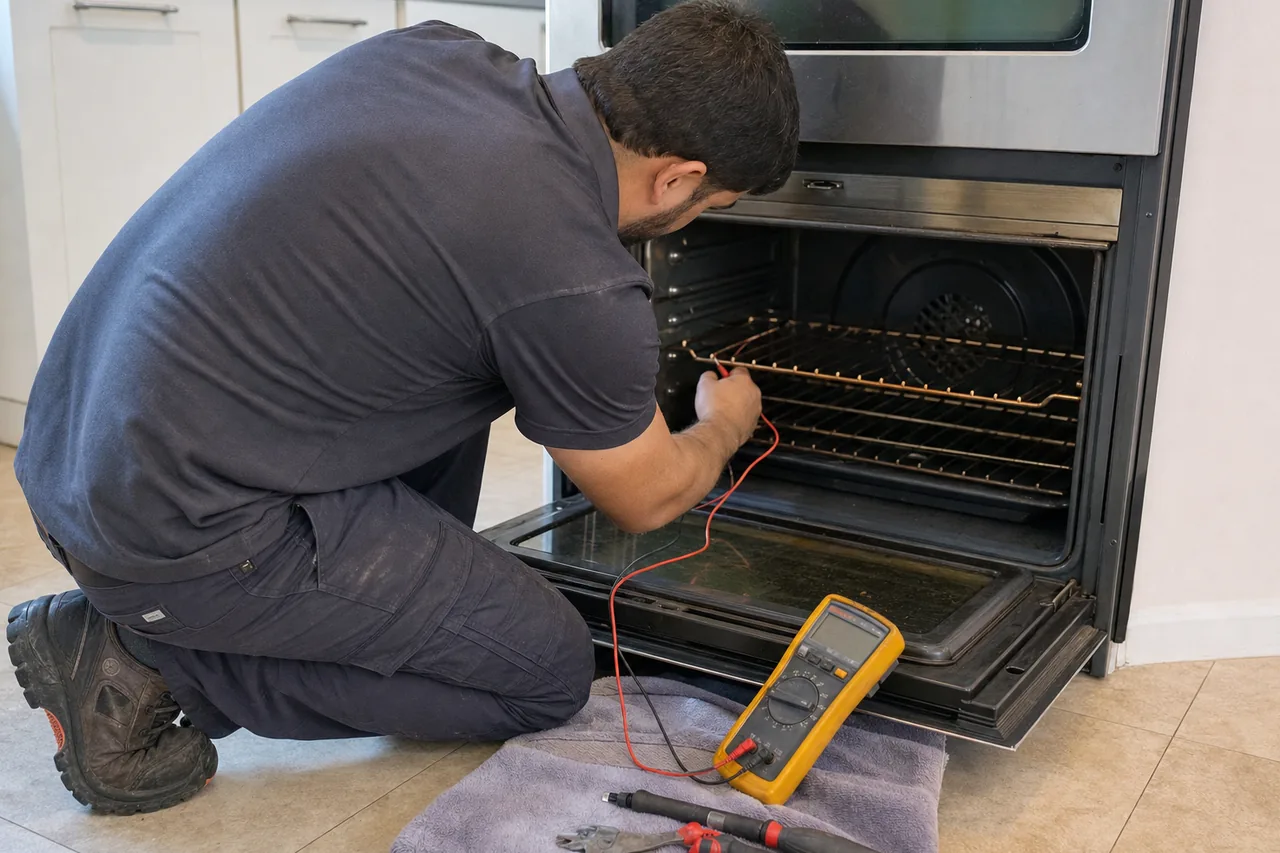
A wall oven is the hardest appliance in the kitchen to get at. It sits inside a cabinet, it is supported by that cabinet, and on a double oven the assembly is heavy enough that pulling it forward is a two-person job with the countertop and the door casings both at risk. That is why a wall oven diagnosis is done as far as possible from the front, and why we tell you before we start if the unit is going to have to come out.
The first thing that goes on the rack is a thermometer, and the first thing we do is nothing — we let a full preheat and a full recovery cycle run and watch what the cavity actually does.
An oven that reads correctly at the set point but swings widely around it has a different fault from one that settles ten or fifteen degrees low and stays there. The first is usually a sensor drifting or a door leaking; the second is often a calibration offset that has never been set, particularly on an oven that was moved from one house to another.
We measure sensor resistance rather than replacing the sensor on suspicion. It is a two-wire measurement that takes a few minutes and it either indicates a fault or rules it out.
Wall oven doors carry their weight on hinges that pivot at the bottom, and after enough cycles the door begins to sit proud at the top. Heat then escapes along the top edge, which shows up as a cavity that cannot hold its set point and as scorching on the cabinet face above the door.
Fogging between the door panes means the seal between them has been breached, usually along with grease finding its way in. That is a door assembly job, not a cleaning job — there is no access path to the inner surfaces that does not go through the door.
Self-clean cycles run the cavity far hotter than any cooking mode, and the components most likely to complain afterwards are the ones that were already marginal. Two things happen often enough to be worth naming.
The door latch can fail to release, leaving the oven locked after the cycle has ended and cooled. That is usually the latch motor or its position switch, not the control board.
A thermal fuse can open, which cuts power to the oven entirely and produces a dead display that looks like a board failure. Replacing the fuse without finding out why it opened is not a repair, so we check the cooling fan and the vent path at the same time.
Jacksonville sees roughly sixty-eight thunderstorm days in an average year, and the appliances that notice are the ones with control boards. A nearby strike or a utility switching event does not have to hit the house to leave a board partially damaged.
The characteristic pattern is an oven that still powers up but has lost one function — a relay for the broil element that no longer closes, a display segment gone dark, a keypad that responds to some presses and not others. We check the incoming supply and the neutral before condemning a board, because a loose connection at the panel can produce the same symptoms and will destroy the replacement board too.
When only one cavity works, the useful question is whether the two cavities share a board, a supply leg, or neither. On many designs they share more than the owner expects, which is why one dead cavity occasionally turns out to be a supply problem affecting a single leg of a 240-volt feed. That is an electrical finding, and we will say so in writing rather than fitting parts into it.
Flat $80 diagnostic, credited toward the repair. Written estimate first, genuine OEM parts, 365 days on parts and 90 days on labour.
Everything starts at the same figure: $80 for the trip and the diagnosis, taken off the repair the moment you say yes to it. What the repair itself comes to depends on which of the bands below the fault turns out to sit in — $180 at the shallow end, $1,030 when the costly component is the one that has gone. That is settled standing at the appliance, never over the telephone.
| Member of the job | Parts and labour |
|---|---|
| The visit and the diagnosis | $80 flat, and it comes off the repair |
| Oven thermostat or heating element | $180–$550 |
| Control board or touch panel | $380–$1,030 |
Bands, not quotes. Nobody here reads you a number down the telephone: the firm figure goes into your hands in writing once the appliance has been looked at, and the invoice matches it. 90 days on labour, 365 days on parts, genuine OEM parts only. The whole book is on the pricing page.
Not necessarily, and it is the most expensive thing to guess at. A transient often takes out the transformer feeding the control, or a thermal fuse, and leaves the board itself sound. We measure the supply under load, check the fuse and the transformer, and only then talk about a board.
With whether it is heating at all or heating badly, because those are two different repairs. No heat at all points at the element, the thermal fuse or the supply, and all three are measured cold in a few minutes. Heat that never arrives points at the sensor, the door seal or a control that is cutting early. We read before we name a part, because the board is the expensive guess.
For a temperature sensor or an element, usually not. For a latch motor, a hinge or anything behind the control head, it has to come forward, and a wall oven in a tight run of cabinets can take longer to free than the repair itself takes. The estimate includes that access rather than discovering it afterwards.
4.4 out of 5, across 65 customer reviews. Each one below is a single visit, in the words of the person who paid for it.
The interior lamp never went out once we closed the door, so the cavity sat warm every morning. A stuck door switch turned out to be the cause. He fitted a new one and tested its twin on the same harness.
Warren E.2026-04-08
Both cavities threw a fault at the end of any long bake. He read the history stored in the control, found the cooling blower stalling as it got hot, and replaced it. Nothing since, across several roasts.
Malcolm G.2026-08-26
Convection fan ran but bread still browned unevenly front to back. He found the fan blade loose on its shaft and the rear baffle bent by a pan. Both were put right and the loaves come out even now.
Denise L.2026-01-12