Our griddle ran hot at one end and cool at the other, so nothing on it cooked evenly. One of its two elements had gone open, and that was what he replaced. Both ends match now, which they had not for a year.
Curtis B.2026-07-02
Independent Viking kitchen appliance repair · Mandarin, FL
Monday – Friday 8:00am – 6:00pm · Saturday 9:00am – 4:00pm
Call (904) 822-9883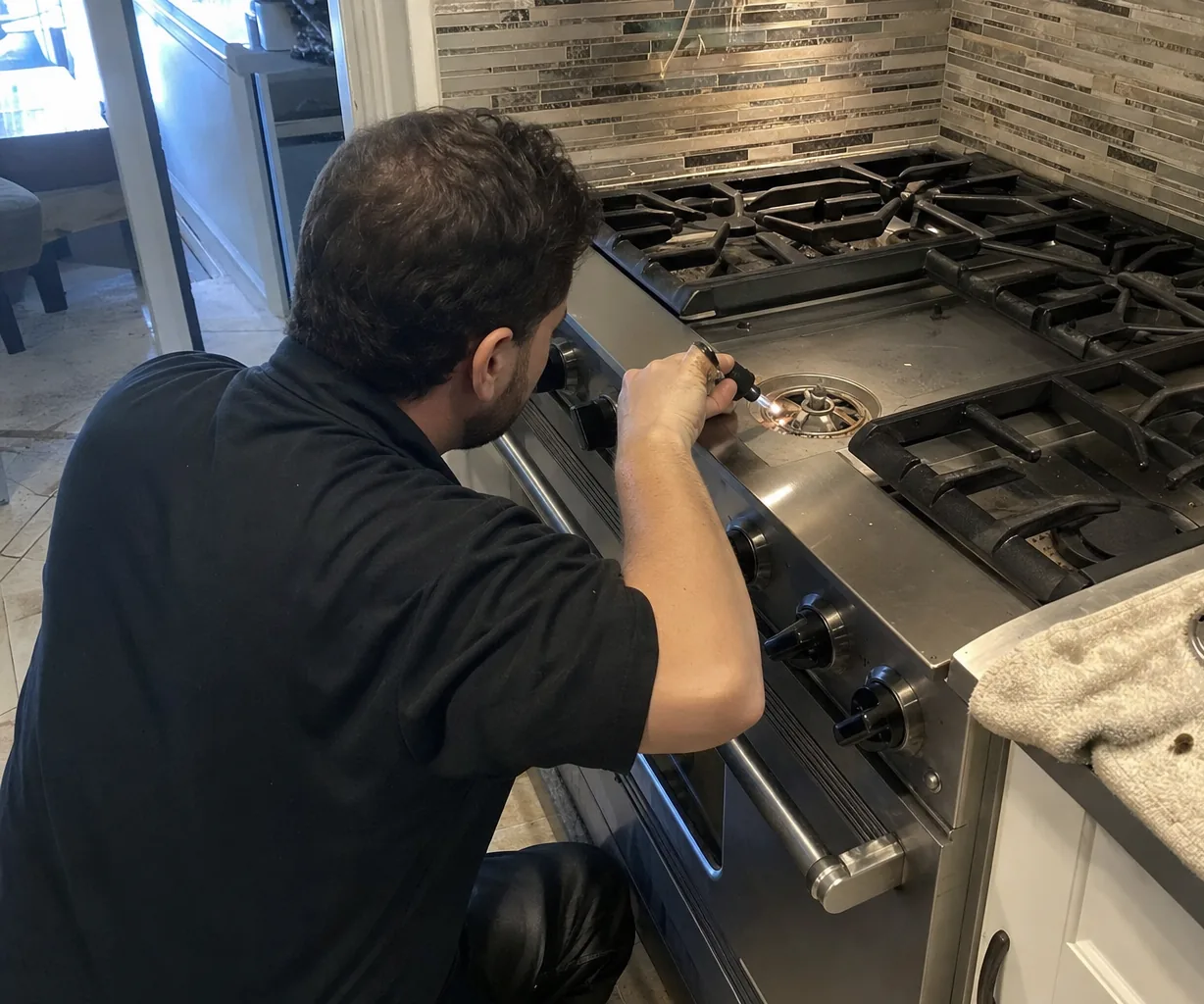
A rangetop sits in the counter with no oven underneath it, which changes what can go wrong and where we have to get to. The gas train, the valves and the spark system all live in a shallow chassis under the cooking surface, and on a drop-in installation the access route is from above, through the burner wells, or from below through the cabinet.
A burner that keeps sparking after it has lit is telling you that the module never received confirmation that a flame exists, or that a switch never opened. The two common physical causes are a wet or soiled electrode and a burner cap sitting a fraction out of position.
Cooktops get washed. Caps get lifted off, cleaned, and put back down rotated slightly or resting on a crumb. The slot that indexes the cap to the burner head exists precisely so the flame lands where the electrode expects it, and a cap that is a few degrees out will click forever without ever satisfying the module.
We seat every cap, check the electrode gap and its ceramic for cracks, and dry anything that is wet before a part is named. If all positions spark when one knob is turned, the fault is at the module or in a switch that is stuck closed, and that is a different repair.
A clean burner burns blue with a defined cone. Yellow, tipping flame means the air-to-gas mixture is wrong: ports partially blocked, the air shutter disturbed, or the appliance running on the wrong fuel setting.
Liquid propane conversions are the usual culprit behind the last one. A conversion is three separate steps — orifices, regulator, and the low-flame adjustment at each valve — and a range converted quickly usually has one of them outstanding. It shows at simmer first, because simmer has the least margin.
Valve stems turn against a high-temperature grease packed in at assembly. Over years of heat that grease migrates and hardens, and the knob gets stiff, gritty, or refuses the last few degrees into the low position.
Forcing a stiff valve is how stems snap. The correct repair is to service or replace the valve, and on a rangetop that means getting into the manifold, which is why we would rather do it at the first sign of stiffness than after the stem has broken off in the knob.
An integrated griddle heats through a plate with a thermostat sensing its underside. Uneven heating is usually the plate itself — warped from a cold liquid hitting it hot — or a thermostat sensing at a spot that no longer contacts the plate properly. Neither is diagnosed from the top; the plate has to come up.
An induction element that cycles rapidly at a low setting is usually behaving correctly: at low power the coil pulses rather than modulating continuously, and you hear it as clicking or as the cookware humming. What is not normal is an element that shuts down after a few minutes at a high setting, which points at the cooling fan, a blocked air path under the unit, or a temperature sensor under the glass.
Induction also depends heavily on the pan. A pan with a slightly domed base or a thin disc bottom will heat poorly and get blamed on the appliance. We check with a known-flat ferrous pan before going further.
The gas supply and the electrical supply. A rangetop needs 120 volts for its spark and controls even though it cooks with gas, and a cooktop that has been sharing a general-purpose circuit in an older Mandarin kitchen will misbehave in ways that look like component failure.
Flat $80 diagnostic, credited toward the repair. Written estimate before anything is opened up or ordered.
Everything starts at the same figure: $80 for the trip and the diagnosis, taken off the repair the moment you say yes to it. What the repair itself comes to depends on which of the bands below the fault turns out to sit in — $200 at the shallow end, $1,030 when the costly component is the one that has gone. That is settled standing at the appliance, never over the telephone.
| Member of the job | Parts and labour |
|---|---|
| The visit and the diagnosis | $80 flat, and it comes off the repair |
| Control board or touch panel | $380–$1,030 |
| Igniter or burner assembly | $200–$530 |
Bands, not quotes. Nobody here reads you a number down the telephone: the firm figure goes into your hands in writing once the appliance has been looked at, and the invoice matches it. 90 days on labour, 365 days on parts, genuine OEM parts only. The whole book is on the pricing page.
It does. Continuous sparking after ignition is a switch letting current across, or an electrode that is cracked and damp, and given long enough it cooks its own wiring. It is also the fault most often left alone, because the burner still lights. The switch pack and the electrode are both replaceable items.
The low end of a burner is set at the bypass screw and held by the safety valve, so the port ring, the bypass setting and the valve are checked in that order. A ring cleaned and never reset will keep flaring back up, and a valve that holds slowly drops out every time the knob is released.
4.4 out of 5, across 65 customer reviews. Each one below is a single visit, in the words of the person who paid for it.
Our griddle ran hot at one end and cool at the other, so nothing on it cooked evenly. One of its two elements had gone open, and that was what he replaced. Both ends match now, which they had not for a year.
Curtis B.2026-07-02
A gas smell near the back of the rangetop worried us. He leak tested every joint with solution, found a loose flare fitting behind the unit, tightened it and retested. Nothing since, and he said what to watch for.
Janelle S.2026-01-30
Sparking carried on after the burner had lit, which it had done for months. He changed the switch pack behind the knob and dressed the wiring away from the heat that had cooked the old one.
Ansel R.2026-06-03