The oven underneath was fine but the whole front row of burners had gone dead. He found the spark module had lost one output, swapped it, and lit every burner twice over while I stood there.
Avery L.2026-09-02
Independent Viking kitchen appliance repair · Mandarin, FL
Monday – Friday 8:00am – 6:00pm · Saturday 9:00am – 4:00pm
Call (904) 822-9883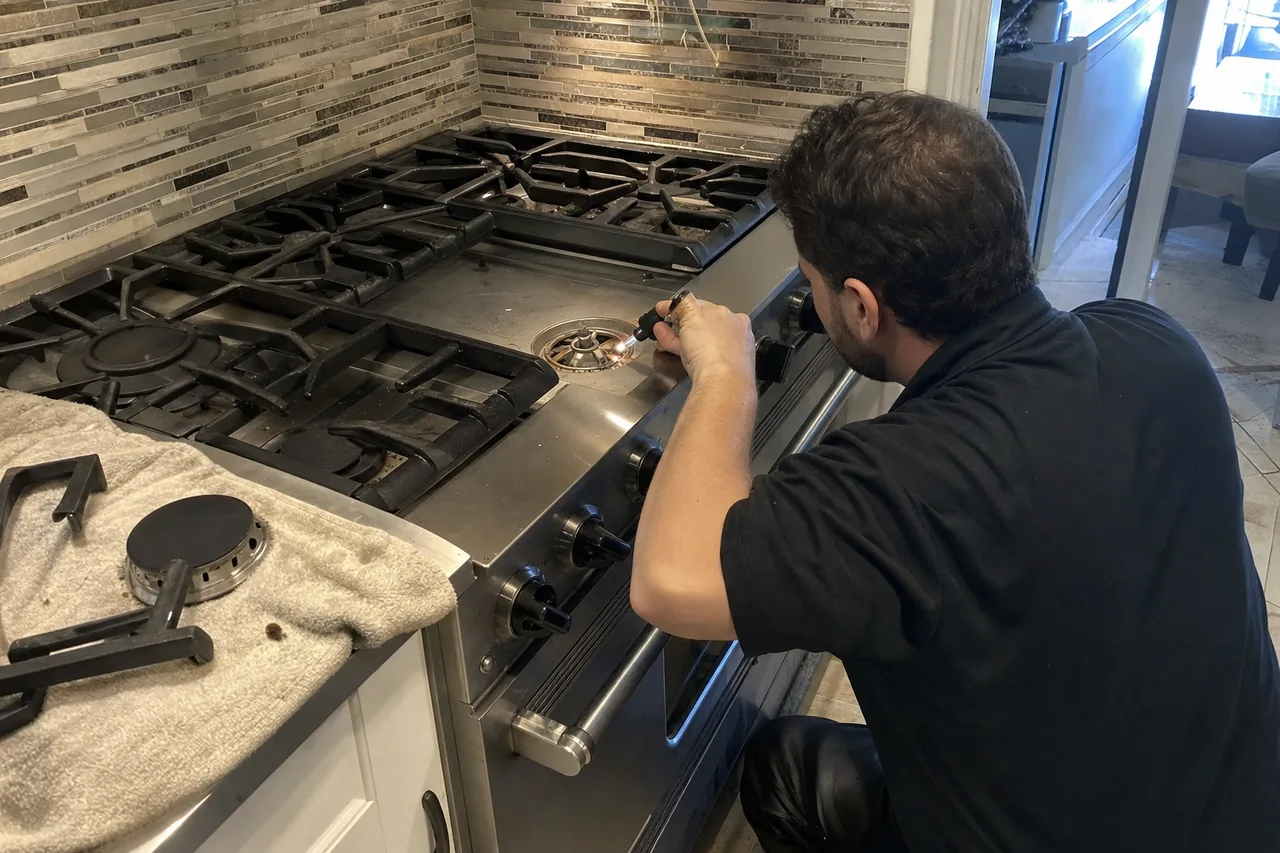
A professional range is heavy, and most Mandarin kitchens were built before that was a residential category. Before anything is diagnosed we check three things that newer construction usually settles on its own: whether the floor under the range has enough structure to carry it without deflection, whether the cabinet opening is genuinely wide enough or has been eased with a saw, and whether the range has a circuit of its own.
Those three questions decide more service calls in 32223 than any single component does. A range that is racked in its opening will never close its door squarely, and a door that does not close squarely will fail a temperature test no matter which sensor is fitted.
An igniter that clicks without lighting is rarely the igniter. More often it is a burner cap seated a few degrees off, a spark electrode that has drifted out of position, or a module firing every electrode at once because one of them is wet.
We test in that order because that is the order in which it is usually true. Lift the cap, seat it flat, check the slot alignment, then look at the gap between electrode and burner rim. A cap that has been washed and set back down at an angle is the single most common cause of a cooktop that clicks forever, and it costs nothing to correct.
If every position sparks when one knob is turned, the fault is upstream at the module or in a switch that is not opening. That is a different repair and a different part, and guessing between them is how people end up paying for two.
A burner that lights strongly and then goes out when turned down is a low-flame problem, not an ignition problem. The usual causes are a partially blocked burner port ring, a valve that has not been turned in a long time and is stiff with old grease, or a gas supply that sags when another appliance on the same line calls for it.
On liquid propane installations we also check that the conversion was actually completed — orifices, regulator setting and the low-flame adjustment are three separate steps, and a range converted in a hurry usually has one of them outstanding. That shows up first at simmer, because simmer is where the margin is thinnest.
Oven complaints get a thermometer on the centre rack and a full cycle before any part is named. A range that overshoots and one that undershoots can share a symptom and have nothing else in common.
We look at the sensor resistance, the door seal, the vent path and the way the oven recovers after the door is opened. On a convection oven we also watch whether the fan is moving air or just making noise — a fan that spins slowly because its motor bearings are dry produces exactly the uneven bake that people blame on the element.
Door hinges on a heavy range carry a lot of weight through a small pivot. When they wear, the door sits slightly proud at the top corners and heat escapes there. You can usually feel it with the back of a hand along the top edge during a bake cycle. Hinges are replaced in pairs; fitting one new hinge against one worn one puts the door back out of square within a few months.
Gaskets are the other half of that repair. A gasket that has gone hard and no longer springs back when pressed is not sealing, whatever it looks like.
Older Mandarin cabinet openings were cut for a 30-inch slide-in. A professional range wants its published clearance to combustible surfaces on both sides and above, and it wants a circuit sized to its rating plate rather than a share of the kitchen’s general-purpose wiring.
If the opening or the circuit is wrong we tell you before we touch the appliance, in writing, rather than fitting a part into a problem a part cannot fix. The written estimate says what the repair costs and what, if anything, needs to change around the appliance for the repair to hold.
Everything starts at the same figure: $80 for the trip and the diagnosis, taken off the repair the moment you say yes to it. What the repair itself comes to depends on which of the bands below the fault turns out to sit in — $180 at the shallow end, $1,030 when the costly component is the one that has gone. That is settled standing at the appliance, never over the telephone.
| Member of the job | Parts and labour |
|---|---|
| The visit and the diagnosis | $80 flat, and it comes off the repair |
| Oven thermostat or heating element | $180–$550 |
| Igniter or burner assembly | $200–$530 |
| Control board or touch panel | $380–$1,030 |
Bands, not quotes. Nobody here reads you a number down the telephone: the firm figure goes into your hands in writing once the appliance has been looked at, and the invoice matches it. 90 days on labour, 365 days on parts, genuine OEM parts only. The whole book is on the pricing page.
Usually. There are three causes worth testing and all three are read at the appliance in minutes: a cracked electrode, a blocked port ring, and a spark module that has lost one output. Electrodes and modules are common enough that we carry them. A burner head that has corroded through has to be ordered, and that is said before anything is opened up.
Because a range that bakes cold can be the sensor, a door that has stopped sealing, or an element drawing low, and from the front those three look identical. A probe left on the centre rack through two full cycles separates them and costs nothing but time. Changing the sensor first is how a door fault ends up paid for twice.
The band table on this page is the answer, and it is the whole of it. The diagnostic is flat and comes off the repair; what the repair runs to depends on which of the bands above the fault turns out to sit in. Igniters, electrodes and spark modules are the shallow end. The electronic control is the dear one. Nobody here quotes a figure before the appliance has been looked at.
On the arithmetic, nearly always. A professional range costs several times its dearest repair to replace, and that is before the opening it stands in, the clearances either side and the circuit behind it are made good for a new one. Where the answer goes the other way it is a parts problem or a fault list, not a price. We set that sum out in full on the repair-or-replace page.
4.4 out of 5, across 65 customer reviews. Each one below is a single visit, in the words of the person who paid for it.
The oven underneath was fine but the whole front row of burners had gone dead. He found the spark module had lost one output, swapped it, and lit every burner twice over while I stood there.
Avery L.2026-09-02
Broil element had failed open with a small burn mark near the rear terminal. He showed me the meter reading before pulling anything, fitted the new element and ran the broiler while I watched. Nothing left behind.
Priya S.2026-06-14
The oven took nearly an hour to reach temperature. He measured the bake element draw, found it low and replaced it, along with a scorched terminal block that was on its way out. Preheat is back where it was.
Duane H.2026-08-04