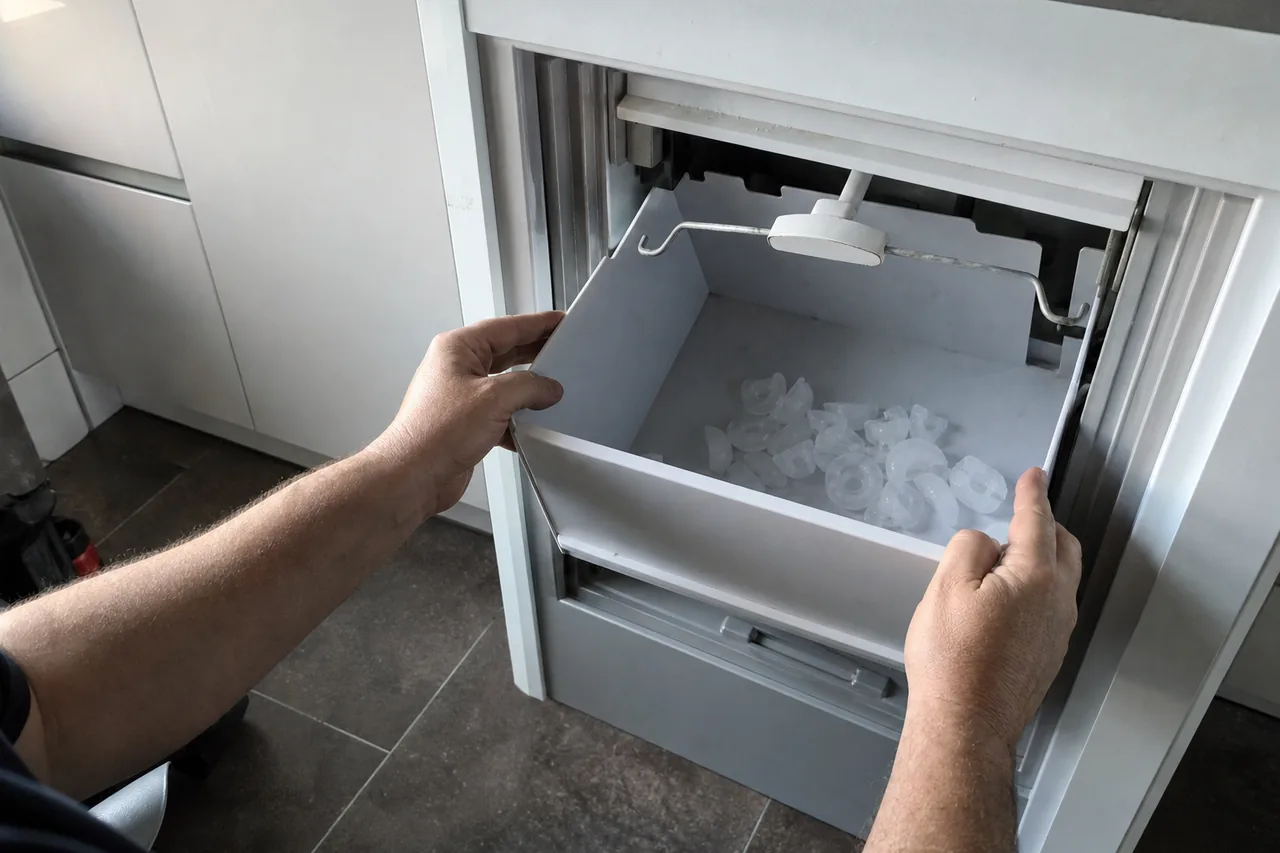
On a Viking built-in refrigerator, the ice maker’s on and off control is the thin wire signal arm, so a reset is a short sequence rather than one button. Lift the arm until it clicks into the up, off position. Switch the refrigerator off at its breaker for a minute or two, turn it back on, then lower the arm to on. Leave it alone for a full day before you judge the result. If the arm is down, the freezer is cold and water is reaching the unit, yet the display stays dark or the tray never fills, the reset is not the issue and something has failed.
The wire arm is the switch
That arm rests on the ice in the bin and tells the ice maker when to stop. Hanging down means on; raised until it clicks means off. Viking’s 5 Series manual puts a lowered arm first on its list when no ice appears, ahead of a cold freezer, an open water valve and a dry supply line. A tall bag of frozen peas or a bin slid back in crooked can lift the arm and stop production with no warning on the display.
To use the arm as a reset, pull the bin out, flip the arm up, wait a minute and push it down again. A clump of fused cubes under the arm will hold it up whatever you do, so clear any jam first, softening stuck ice with a warm damp cloth rather than prying at it with a knife.
Cycle the power at the breaker
If the arm is down and nothing changes, restart the electronics. On a built-in, the plug often sits behind cabinetry, so the panel breaker is the practical switch. Turn it off, wait one to two minutes so the control fully drains, then turn it on. The display should wake and the compressor should start soon after.
While you are at the panel, look at the circuit itself. Viking calls for a 115 volt, 15 amp dedicated circuit on its FDREIC integrated all-refrigerator, and one sharing a breaker with a microwave can trip it. A breaker that will not stay on is an electrical fault no reset will cure. Summer thunderstorms in Mandarin can drop and restore power several times in a minute; afterwards, a breaker cycle is the first thing to try.
Lockouts that make a working ice maker look dead
Two settings stop ice on purpose. Sabbath mode on a 5 Series built-in begins with the bale arm raised until it clicks; the owner then presses ACTIVATE CONTROLS and holds it together with DISPLAY OFF for three seconds, three beeps sound, and SAB lights on the display. If you see SAB, the ice maker is off by design. Leave Sabbath mode using the steps in your manual, then lower the arm.
On 7 Series integrated models, holding VAC and ALARM together for 3 seconds switches showroom mode on or off. In that mode only the interior lights work; cooling, ice and fault codes are all shut off. A unit that lights up but stays warm after someone has been pressing buttons may simply be in showroom mode, and the same hold brings it back.
Separate ice machines restart on their own
A standalone Viking ice machine needs no manual reset after a water interruption. That covers the FGIM5151 and FPIM5151 clear ice units and the FGNI515 and FPNI515 nugget units. When the Check Water light flashes blue, the machine has lost its supply. Open the shutoff, straighten a kinked line or finish the plumbing job, and the control picks it up by itself, since it looks for water every 20 minutes and resumes making ice once it finds it.
The Time to Clean light on the FGIM5151 is a different matter. It comes on after 6 months of use and stays lit until the ice-making system has been cleaned, so cycling power will not clear it. Viking wants that cleaning done at least once a year, and twice is better.
Give the reset time before you judge it
An empty bin an hour after a reset proves nothing. A freezer that warmed up during an outage has to get cold again before the ice maker will cycle, and that can take overnight. A VEIL integrated freezer needs 12 to 24 hours after activation to start, then turns out only about 10 cubes every two hours. A newly installed 5 Series can take 24 to 48 hours. Throw out the first batch in each case: one bucket on the integrated units, the first three full drawers on a new 5 Series, and the first drawer after the unit has sat unused for a long stretch.
Signs the problem is a part, not a setting
| Symptom | Likely cause | What you can check | When to call |
|---|---|---|---|
| Arm down, still no ice after a day | Water supply or a frozen fill tube | Valve open, line not kinked or leaking | Tray stays dry after 24 hours |
| Display completely dark | No power or a failed control | Breaker on, outlet live | Power is there but the screen stays blank |
| A 5 Series display reads oPn or Shr | Its sensor alarm has tripped | Clear it with ALARM OFF | No temperature shows afterwards |
| Check Water flashing blue | Water supply interrupted | Restore water, wait 20 minutes | The light keeps coming back with water on |
A screen that stays blank with the breaker on points to a power supply or control failure. An ice maker that hums or starts to turn but never finishes a cycle usually has a worn motor or heater in the module. For the 5 Series sensor alarms, Viking is direct: if ALARM OFF does not bring the temperature back, get a technician out right away, because food safety is now at stake.
An $80 diagnostic measures voltage at the control and at the ice maker, which separates a dead board from a dead module before any part is ordered. If testing shows a failed board or touch panel, plan on $380–$1,030 as the typical range; the firm figure follows the diagnosis. Our Viking refrigerator repair page covers other refrigeration faults, and if the ice is fine but tastes off, see the note on stale ice.