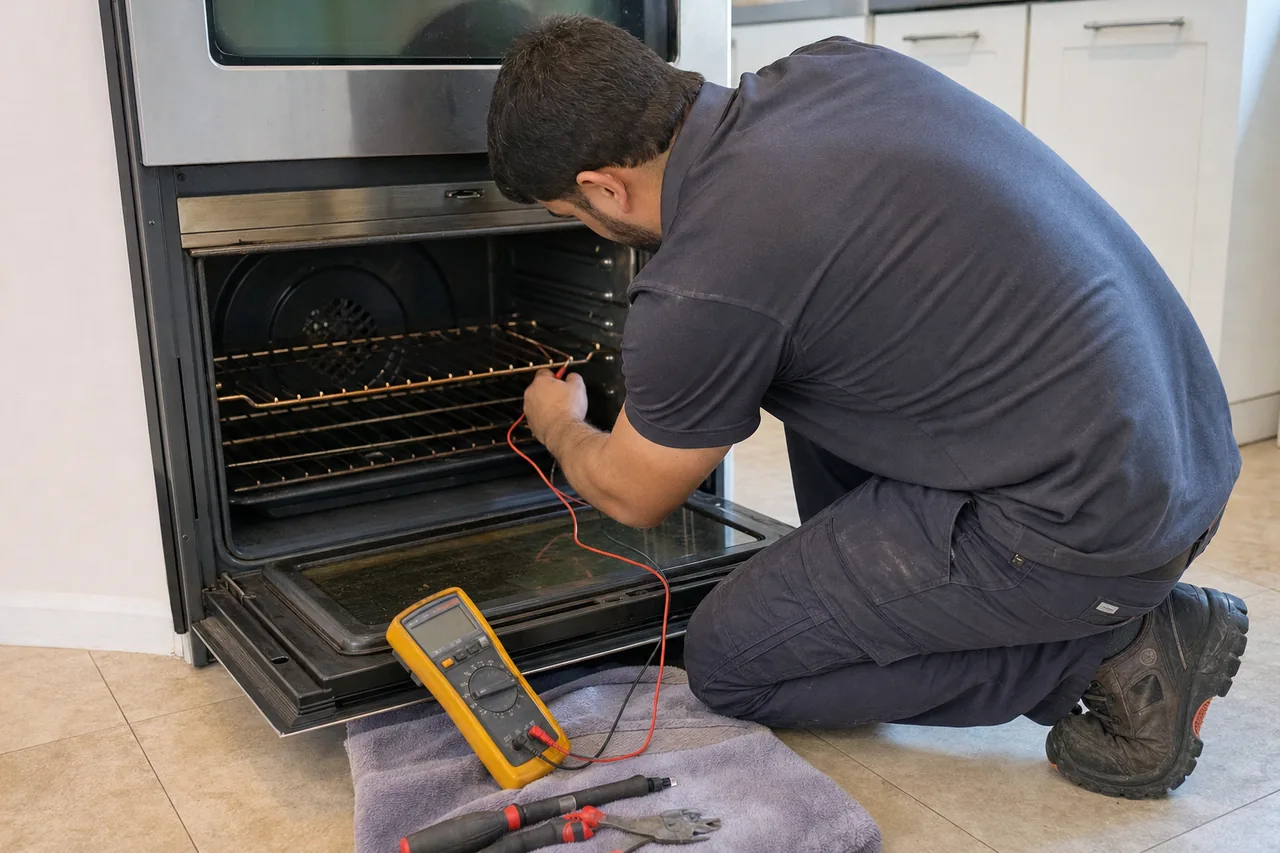
There is a way of working in this trade where you change the cheapest likely part first, and if the symptom persists you change the next one. It usually gets there eventually. It is also why people end up paying for two repairs and getting one.
We do not work that way, and the reason is not virtue — it is that the diagnostic is a flat $80 whether the answer takes ten minutes or fifty, so there is no commercial reason to guess.
The full cycle rule
An oven complaint gets a thermometer on the centre rack and a complete cycle before any part is named. That means preheat, the signal that it has reached temperature, a period of holding, and at least one recovery after the door has been opened.
Watching all four tells you which fault you have:
- Reads correctly at the set point but swings widely around it — usually a sensor drifting or a door leaking.
- Settles ten or fifteen degrees low and stays there — often a calibration offset that was never set, common on an appliance that moved house.
- Preheats slowly and recovers slowly — an element, a leaking door seal, or an oven that is not sealing at the top corners because its hinges have worn.
- Bakes unevenly front to back with a convection fan running — a fan that is turning slowly on dry bearings rather than the element everybody blames.
Those four require four different repairs. From the front of the appliance, with the door shut, they look like one complaint: “the oven is not right.”
The order for ignition
A burner that clicks and will not light gets checked in this order, because this is the order in which it is usually true:
- Is the burner cap seated flat and indexed to its slot? A cap put back rotated slightly after cleaning is the most common cause we see, and it costs nothing to correct.
- Is the electrode gap right, and is the ceramic intact?
- Is anything wet? Water on one electrode makes a module fire all of them.
- Does one knob spark every position? That points upstream to the module or a switch that is not opening.
- Only then, the component.
Starting at step five and working backwards is how a spark module gets replaced on a cooktop whose real problem was a burner cap.
Resistance, not replacement
An oven temperature sensor is a two-wire component with a resistance that varies predictably with temperature. Measuring it takes a few minutes and either indicates a fault or rules it out. Replacing it on suspicion takes about the same time and costs the price of a sensor to learn the same thing.
The same applies to elements, thermal fuses, latch switches and fan motors. Almost everything in these appliances can be measured, and the measurement is faster than the part is to obtain.
What we cannot measure
Some findings are judgement rather than measurement: a gasket that no longer springs back when pressed, a blower wheel that is out of balance with grease, a valve stem that is stiff but has not yet seized, a floor that flexes underfoot when the range is rolled out.
Those go in the estimate described exactly as we found them, so you can weigh them yourself. We will tell you when something is “will fail” versus “is failing” versus “has failed”, because those three deserve different decisions.
What you get
A flat $80 diagnostic, credited toward the repair when you approve the work, and a written estimate before anything is opened up or ordered. If the diagnosis comes back as no fault in the appliance — a bin arm resting on a bag of frozen food, a rinse aid reservoir that has been empty for a year, an ice maker switched off — you will hear that, and you will pay the diagnostic and nothing else.
Being independent is what makes that possible. There is no parts quota behind this work.